

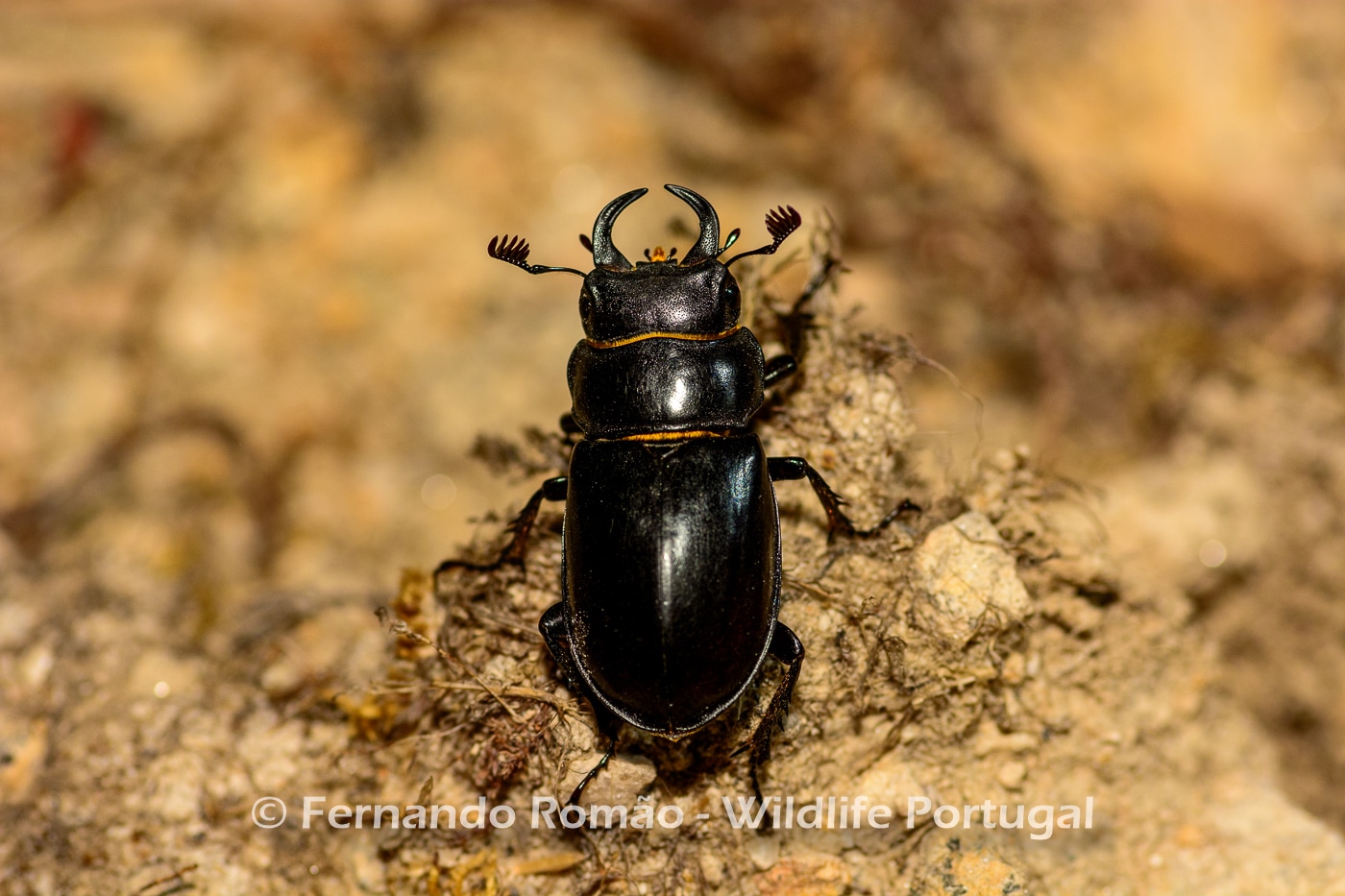
Meet Lucanus barbarossa
In the forests of the Greater Côa Valley, where granite and schist meet pyrenean oak and cork oak, lives one of the most impressive beetles of the Iberian Peninsula: Lucanus barbarossa, locally known as “vaca-ruiva” or stag beetle.
With its reddish-brown body and powerful mandibles (especially in males), this coleopteran of the Lucanidae family is easily confused with its larger cousin, the European stag beetle (Lucanus cervus), but is distinguished by its lighter coloration and slightly smaller size.
The life cycle of Lucanus barbarossa is marked by patience. The larvae develop over 2 to 3 years inside decaying dead wood, feeding on cellulose and fungi. This underground phase is crucial: by decomposing wood, they accelerate the nutrient recycling process and create micro-habitats for other organisms.
The adults, which emerge between May and July, live only a few weeks. Their goal is reproduction. Males use their impressive mandibles not to feed, but to fight rivals for access to females – true duels that seem straight out of an ancient epic.
Lucanus barbarossa is a bioindicator of forest quality. Its presence signals healthy ecosystems with available dead wood in various stages of decomposition – an essential resource that intensive forest management tends to eliminate.
By decomposing wood, this beetle:
– Releases essential nutrients into the soil
– Creates cavities that serve as shelter for other species
– Promotes the diversity of associated fungi and invertebrates
In the context of the Greater Côa Valley, the conservation of this species is intrinsically linked to the preservation of traditional oak and cork oak forests, where dead wood is not “cleaned up” but recognized as a vital part of the ecosystem.
Protecting Lucanus barbarossa means protecting living forests, where the natural cycle of life and death completes itself without excessive interference. Next time you walk through the Côa territory at dusk, stay alert: you might witness the heavy flight of this red guardian of our forests.


Comment (0)